Showing posts with label Research. Show all posts

30 April 2010

SPARC inclusion


A while ago I sent an abstract relating to this Sshhh project for consideration within SPARC: the Salford Postgraduate Annual Research Conference. Today they got in touch to say that my request to be part of the poster section was successful. So I now need to consider how something will work within their programme. I'll have to devise a poster which uses images and text to outline my research. And do a short presentation in front of a judging panel. Which is great. But, y'know, it's another deadline.

And I have loads of deadlines.

That said, this is something I can concentrate on immediately after hand-in for the three current Masters modules and should help me formulate exactly what I'll be concentrating on delivering at the Bigger Than Words conference.

22 April 2010

Design Industry and Professional Practice assignment


Today I'm working on the essay for the Design Industry & Professional Practice module. It's actually my least favourite class. Possibly because it doesn't really suit my more typical way of working and also because it's very 'design management' influenced [and I can be a bit of a design management skeptic at times].

That said, I still need to turn in an assignment. I'm looking at the arguments for professional accreditation for the UK graphic design industry: a subject that has received more coverage of late due to a push by the Chartered Institute of Design. It also gathered a bit more momentum following the unwarranted criticism about the NHS 60 logo not long ago. Tomorrow we've got a tutorial to get some feedback on what we're doing, where we're up to, etc.

As a little diversion - and to try and develop some enthusiasm for the model we're following to prepare this report - I decided to spend a little bit of time thinking about a front cover for when it's finished. After messing around with some of the geometry that I'm using for the Negotiated Project module, I eventually did the above. It's supposed to be a graphic suggestion of how a fragmented industry may become united through accreditation. I liked incorporating some rough looking text for this one as recent projects have been a bit bolder type-wise. Plus it picks up on some of the little irregularities in the lining paper that it's printed on. Anyway... better get on with the essay itself now...

18 April 2010

Old vs New


One thing that I've been considering is how to bring together the heritage that the British Library represents and more contemporary ideas. The building itself could already be perceived as not being sympathetic to the more historic aspects of the organization's activities, so I'm suggesting that I don't have to develop something that has some "sentimental" appreciation of the past. However, we discussed in the group tutorial a while back how this product would work for two audiences: one that holds the belief that it captures the essence of the British Library and one that sees it more as a design-led curiosity.

One decision I've made is to ensure that externally it doesn't feel like it leans too strongly one way or the other. I really like the book cloth when used with strong typography and feel that it presents a good, but simple, fusion of modern and traditional. So the intention is to bind the package (as a book) with the cloth with some basic information presented in a strong, graphic way. The text will adhere to the British Library's brand guidelines.

Internally I want it to be more challenging and blend a number of different elements: the sound visualizations, the documentation of the environment, the grids based on the axonometric views, copy relating to the organization, etc. The above referenced images are to help illustrate another suggestion: the coming together of the traditional elements with the contemporary. The idea is that this kind of suggestion of the historic alongside obvious digital age additions is more than just a way of highlighting a visual tension between disparate elements. It actually represents a shorthand for the way that the organization works and would also be defining a style that is supposed to work on a cheekier, irreverent level in addition to it also being able to suggest a weightier, respectful approximation when read by a different audience.

15 April 2010

Virtual Worlds Research book


I completed my Virtual Worlds research book today. It was also an opportunity to try working with some of the materials that I'll be using for the Negotiated Project deliverable.

What this process demonstrated was that I need to be more patient. It could certainly be more precisely executed but isn't that bad. At least not for a first effort.


08 April 2010

Rainbow Sound Collision by Eva Schindling

Rainbow Sound Collision from evsc on Vimeo.


Circuit Explorations - Tube Visualization from evsc on Vimeo.


Some intriguing work at Eva Schindling's site http://www.evsc.net (although I'm not sure if I'm close to understanding a large amount of it). Amy spotted this link alongside some others which I'll post later. [I especially appreciate it given that she's ill at the moment. Get well soon.]

Anyway, today I've been getting my research file organised. I think it's completed. I don't want to look at any other theoretical ideas as I already have far too much to put into this report. In fact it looks like I'll struggle to get another sheet of paper in the lever arch file.

I also drafted a list of what I think I need to do to complete this project and the other two (smaller) modules for our deadline in May. It's quite a lot but, really, there's no point stressing about it. It will get done. I'm sure. And then I'm going to have a holiday. A proper read a book in the sun holiday. I certainly won't be visiting any libraries.

07 April 2010

Stonehouse & Stromberg's The Architecture of the British Library at St Pancras


I had to create a special order for The Architecture of the British Library at St Pancras by Stonehouse & Stromberg. They do list it at Amazon but it's around 70 quid. So instead - for the bargain price of £2.50 - I got the university to loan a copy on my behalf. It was actually sent from the British Library itself.

Anyway, aside from liking the idea of a book on loan from the British Library that's about the British Library, it's a really useful resource. It has all the architectural plans alongside some tasteful photography. The layout is nice too but it's the accompanying text which explains more about what the architecture was trying to evoke that might assist in the upcoming design work. There seems to be a philosophy behind the environment that I may be able to incorporate when producing this project's deliverables.

If you are a bit flush, you can buy it here: The Architecture of the British Library at St.Pancras

06 April 2010

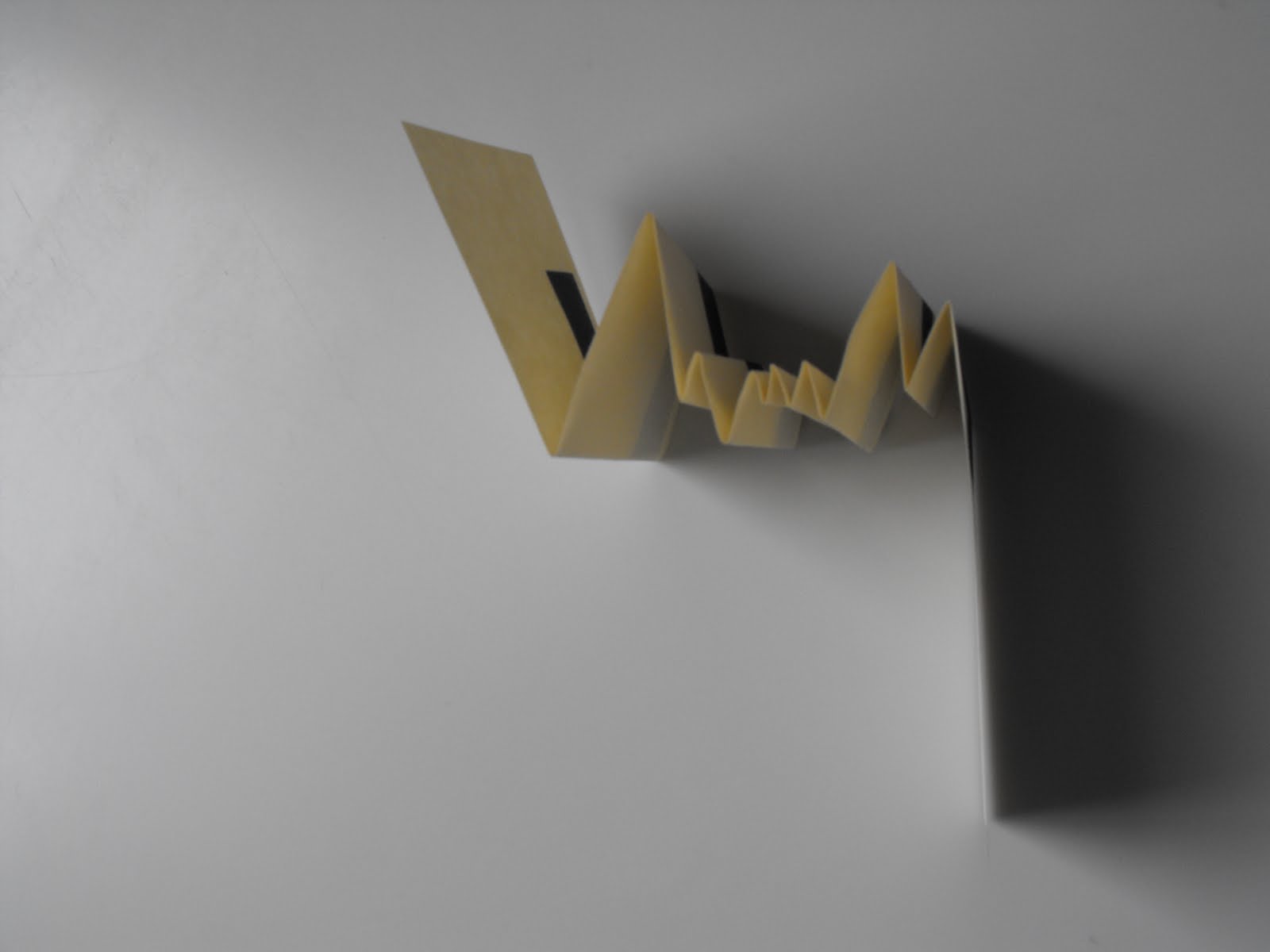
Waveform from folded paper


A little experiment to see what shape some of the waveforms might take if their line was used as a series of folds. I jotted this idea down ages ago so just wanted to get it out of my system here.

03 April 2010

Print and bookcloth reference


I made a bit of an impulse purchase at Ratchford. Faced with rolls and rolls of bookcloth, I found myself saying "red" when asked what colour I was looking for. Then confronted with a pile of different reds, I ended up - in a state of confusion - opting for a two tone product that is a red woven thread across a blue background (above).

I had expected Ratchford to be a shop where I could just browse and agonise over materials for ages but it's predominantly a wholesale company. So when someone was taking time out from dealing with a massive order to assist with a poxy metre of book cloth and a few other sundries, it made sense to be that bit more decisive. So this snap decision has suddenly informed the colourway for the finished product. (The red, by the way, was to keep it working within the British Library's brand guidelines.)

This is not necessarily a bad thing. In fact it has just focussed what I'm doing with the print aspect as I have something definite for it to work alongside. So I've subsequently developed a treatment for the photography that I believe compliments the hue of the cover.

Also I was re-reading my undergraduate dissertation the other day [not for fun - just because there are parts of it that are relevant to my PhD application] and I had interviewed the boss of Azuli Records about how they approached the design for the label when it first launched. Despite being based in London, Azuli capitalized on what was then a demand for American releases by faking their origins and positioning itself as a New York label. The tracks were even shrinkwrapped and had a Stateside telephone number on them. Anyway, they were saying that a problem with the early logo design was that the US labels used old printing presses for the details on the records. Over here in the UK - where the records were manufactured - the print was of a superior quality. To combat this slick printing, they did some photocopies of the original logo to rough it up a little before handing this more ragged artwork to the printer. The suddenly more lo-fi interpretation suddenly had the authenticity required to be able to charge a couple of quid more for a record assumed to be an import.

This inspired me to see what would happen if I was to try out a similar approach with the photos: so that they were printed and re-scanned so they lose some of their sheen. The reason for this was to try and capture some of the qualities of the print that had first caught my attention when looking at vintage paperbacks. I had toyed with the idea of carrying out some traditional printing techniques but - as Amy discovered with last semester's project and Dave has found out through his current work - more contemporary processes can be much more convenient. So the above is an attempt to put some of the graininess into the print without resorting to derivative Photoshop filters. They have also been printed on cream coloured paper just to knock back the tones that bit further (while also relating to the kind of cheap buff stock that is used in paperbacks). I'm also suggesting that these re-scanned versions then be printed on quality white stock just to give some contrast between the imagery - that will then have some sort of heritage feel - and some crisp typographic elements. I also tried out the same re-printed method out with the logo (below)


31 March 2010

Sonic Warfare: Sound, Affect, and the Ecology of Fear by Steve Goodman

Yesterday I saw Dr. Michael Goddard - one of the organisers of the Bigger Than Words, Wider Than Pictures conference. We actually met to discuss the PhD proposal I'm putting together with his help but we also chatted briefly about the upcoming event. There's some great stuff planned. We touched on my contribution and Michael suggested that I might be interested in reading a recent book by Steve Goodman titled Sonic Warfare: Sound, Affect, and the Ecology of Fear.

So I Googled it when I got home and realised that Steve Goodman is the same Steve Goodman that I actually know through his work with the Hyperdub label. There he's more noticeable as Kode 9 and, as label boss, is responsible for releasing groundbreaking music by the likes of Burial, Zomby, Flying Lotus, Martyn, Samiyam, Joker and more. In fact I interviewed him back in 2008 for something else.

What I didn't realise then is that the guy who has also pushed innovative electronic sounds via fanzines and club nights also has a very impressive academic career. With a PhD in philosophy he has apparently studied rave culture, cybernetics and postmodernism and now this book journeys through “philosophy, science, fiction, aesthetics, and popular culture, as he maps a (dis)continuum of vibrational force, encompassing police and military research into acoustic means of crowd control, the corporate deployment of sonic branding, and the intense sonic encounters of sound art and music culture”. A read then perhaps as heavy as one of his DJ sets.

Anyway, I've now got it on order from Amazon.

Available via the following link: Sonic Warfare: Sound, Affect, and the Ecology of Fear (Technologies of Lived Abstraction Series)

28 March 2010

Bigger Than Words, Wider Than Pictures invitation


After answering the call for submissions, I've just received notification that I have been invited to participate in the Bigger Than Words, Wider Than Pictures conference. So I'll need to think about exactly what I'll be delivering there. One more recent development has been the news that it won't be partly curated at Islington Mill (as previously suggested) due to it seemingly following Central Library's example and closing for refurbishment.

I'm also looking into the potential for external funding/sponsorship so that I can produce something even more ambitious for July's event. Perhaps an installation or have the findings culminate in a publication that could be printed and distributed in significant numbers. However the hand-in date for this project is in May so any additional work would be for myself (i.e. it wouldn't be assessed as part of this Masters work) but I guess the development of the ideas would be part of my conclusion. The real concern would be whether this could become so all-consuming that it would be too distracting at a time when I'm supposed to be working on my major dissertation work. Unless, of course, I work this into that (as yet unspecified) project.

25 March 2010

Identity based on "sonic energy"

Amy found this. It's really interesting: a graphic design agency used the sounds from a client's environment - a school - to develop a unique identity.

Visualising Sound


We're currently just working on the final touches to an identity which is generated by audio taken from the environment the client works in. We developed an application that creates patterns based on different frequencies within the audio being read. Here's a sneaky peek of how it's looking.


More here: www.taktak.net

14 March 2010

British Library project


As mentioned in the previous post, this project has moved on from being one primarily concerned with comparisons between the noise in different libraries and has become one about documenting how it occurs within a specific space. As yesterday's visit might suggest, I've opted for the British Library.

The British Library is iconic given the fact that it is required by law to carry a copy of every book that is produced in the United Kingdom. And, while its architecture divides opinion, I felt it was an interesting environment.

What especially interests me is the balance between this very weighty tradition and the more abstract aspects of the building. Located somewhere between these two elements is this thing called noise. As discussed in last week's group tutorial, I want to [half-jokingly and half-seriously] create something that reflects how the sounds of the British Library have a quality that carries the essence of all this information and intellectual endeavour. I mean, the amount of people who go to study there suggest that the environment has more than wi-fi when it comes to that ability to inspire. So in terms of deliverables, this has become about the ability to commodify this essence: maybe in the way that, say, "Holy Water" is bottled at Lourdes.

So now I'm developing the idea of selling the sounds of the British Library as a package. Something that can be perceived as a potent study aid or an 'environment enhancer' that may suddenly turn your Jackie Collins paperbacks into weighty tomes. Perhaps while instantly increasing your IQ. But then also something that is more of a curio: a novelty gift if we have our tongue firmly in our cheeks.

Above is a quick interpretation of how it could be packaged using one of the photos I took yesterday. It also uses the design layouts that are used in existing British Library material. The plan is to produce it alongside some kind of print product that will explain more about the environment, the British Library's work and the sounds that were recorded.

Interestingly, they already sell CDs of birdsong and rainforest sounds in the British Library's gift shop.

13 March 2010

Visit to the British Library


I took a trip to the British Library today and hopefully got everything I needed. I recorded some of the sounds around the building and took plenty of photographs.

Although while I was there, I felt myself more attracted to the architecture of the place rather than the books. The recordings also seem to be noisier than I had expected although that might be because I am studying this perceived "silence". Subsequently the (fuzzy) image that I had in my head about what this project might look like has disappeared.

I also paid particular attention to the gift shop given that the focus of this project is now to use silence as a commodity and specific environments as a sign of quality to create a marketable product. More on that all later once I've had time to digest and post the material that I collected today. Plus the train journey helped me get on top of my reading while I managed to attack a chunk of the report too. On reflection, it wasn't a bad day at all.

(The above image, by the way, is today's checklist.)


11 March 2010

"What Is Noise?"

Taken from Noisemap: http://www.noisemap.com/


Noise is often defined as ‘sound which is undesired by the recipient’. A sound which one person finds enjoyable, such as some music perhaps, could be very annoying to another person who doesn’t want to hear it. Since it is quite probable that whatever the noise, there will be someone who doesn’t like it, there is a common presumption that all sound is bad. This presumption is even the basis of some legislation, which often seeks to limit sound levels on the basis that any sound could be annoying to someone.

However, this presumption is by no means always true. Individual sensitivity to noise varies greatly and some people are not bothered by noise that would be intolerable to others. Moreover, there are many situations where noise is appropriate: for example a football match conducted in silence would be unnatural and hardly enjoyable for fans.

In English law, it is illegal to create noise which amounts to a nuisance, but in Common Law, the test is whether an ordinary person, taking account of the circumstances, would find the noise to interfere with the ‘enjoyment’ of their land to a material degree. Statute Law has changed the situation in recent years, and objective noise tests are becoming more important.

It is relatively easy to devise measurement units that can measure sound level, but because noise perception is subjective (ie it depends on the listener), acousticians have not been able to find a perfect unit or index for measuring noise.

This means that acousticians use a variety of measurement units that describe sound levels in a variety of ways. Using these as a guide to the impact of noise on people requires careful interpretation by skilled practitioners.

However, increasing regulation, both national and European, is changing the situation, so that assessments are now more likely to depend on taking noise measurements in accordance with a defined procedure and for the result to be compared with objective guidelines.


20 February 2010

Herwig Weiser's electrochemical sound-modules


These are beautiful looking although, as a work in progress, I'm not really sure what their function is.

In any case, Herwig Weiser makes some arresting, sometimes highly conceptual, projects that use technology and, in some cases, sound. More via his site - http://www.zgodlocator.org/.

Silence in the words of...

A lift from the blog of Berlin sound artist Andreas Bick (http://silentlistening.wordpress.com/) which collects a number of quotes based around the concept of "silence".


Silence a boundary notion, a conceptual ideal, an aural vanishing point. Saying something about silence equals losing it. Being silent is impossible may it include to cease living. Many words have been uttered to grasp this paradox.

There is no such thing as silence. Something is always happening that makes a sound.

No Silence exists, that is not pregnant with sound.

Until I die there will be sounds. And they will continue following my death. - John Cage


Silence is a word which is not a word, and breathes an object which is not an object. - Georges Bataille


We should be sensitive to the thread of silence from which the tissue of speech is woven. - Maurice Merleau-Ponty


There are two silences. One when no word is spoken. The other when perhaps a torrent of language is being employed. This speech is speaking of a language locked beneath it. That is the continual reference. The speech we hear is an indication of that we don’t hear. It is a necessary avoidance, a sly, anguished or mocking smokescreen which keeps the other in its place. - Harold Pinter


Noise may have lost its power to offend. Silence hasn’t. - Dan Warburton


The fear of silence is nothing new. Silence surrounds the dark world of death. Sometimes the silence of the vast universe hovers over us, enveloping us. There ist he intense silence of birth, the quiet silence of one’s return to the earth. Hasn’t art been the human creature’s rebellion against silence? Poetry and music were born when man first uttered sound, resisting the silence. - Toru Takemitsu


When silence is conceived as the rejection of the human personality, the ulitmate silence is death. Then man likes to surround himself with sounds in order to nourish his fantasy of perpetual life. In Western society silence is negative, an embarrassment, a vacuum. Silence for Western man equals communication hangup. If one does not speak, the other will speak. - R. Murray Schafer


The essence of sound is felt in both motion and silence, it passes from existent to nonexistent. When there is no sound, it is said that there is no hearing, but that does not mean that hearing has lost its preparedness. Indeed, when there is no sound, hearing is most alert, and when there is sound the hearing nature is least developed. - Kirpal Singh


But if it’s true that all symphonies end in silence, it’s equally true that they begin there as well. Silence, after all, both buries and births us, and just as life without the counterweight of mortality would mean nothing, so silence alone, by offering itself as the eternal Other, makes our music possible. - Marc Slouka


Any given silence takes its identity as a stretch of time being perforated by sound. A genuine emptiness, a pure silence, are not feasible — either conceptually or in fact. If only because the art-work exists in a world furnished with many other things, the artist who creates silence or emptiness must produce something dialectical: a full void, an enriching emptiness, a resonating or eloquent silence. Silence remains, inescapably, a form of speech (in many instances, of complaint or indictment) and an element in a dialogue. - Susan Sontag


There is a beautiful page with lots of writings about silence. And please check the essay „The Aesthetics of Silence“ of Susan Sontag.

How Vision Affects Sound Processing

Source: http://musicalbionics.wordpress.com/

Publication date: January 18, 2010


There are a pair of papers in the most recent issue of Current Biology that got my attention thismorning.

There’s an original research article (Kayser, Logothetis, & Panzeri, 2010), and a handy review (Ghazanfar & Lemus, 2010). Full refs below.

There has been a flurry of recent research indicating that visual stimuli can influence activity in what were previously thought to be purely “auditory” areas of the brain – from the (relatively) high levels of the auditory cortex (Kayser, Petkov, & Logothetis, 2008) right down to the brainstem (Musacchia, Sams, Skoe, & Kraus, 2007). Interestingly, the effects of visual stimuli on activity in the brainstem seem to be even larger in musicians, but that’s a story for another time. It’s been mostly assumed, naturally enough, that the enhancements in behaviour (in the form of decreased reaction times, detection thresholds etc) are due to enhanced neural responses in the brain elicited by multisensory stimuli. Until recently, this assumption has never really been tested. Kayser et al (2010) tested this, by comparing the amount of stimulus-relevant information carried by neural responses in the auditory cortex of alert monkeys, who were watching videos of monkey vocalisations.

In addition to finding enhanced activity to multisensory stimuli, they also found an interesting relationship with the auditory-only responses. As is often found in these types of studies, the amount of enhancement gained from the multisensory stimuli increased as the auditory-only responses decreased. That is, the biggest gains occurred when the auditory signal alone was weakest. Strong auditory responses were actually suppressed by the addition of visual stimuli. At the same time, the information content of the auditory cortex activity increased. So, when congruent auditory-visual stimuli are presented, the effect of information from the visual system seems to selectively suppress strong auditory activity, which in turn reduces its variability, and increases its information content. Conversely, weak auditory signals are amplified by visual information, but at the expense of increased variability and lower information content.


Musacchia, G., Sams, M., Skoe, E., & Kraus, N. (2007). Musicians have enhanced subcortical auditory and audiovisual processing of speech and music. Proceedings of the National Academy of Sciences, 104(40), 15894-15898. doi: 10.1073/pnas.0701498104

Ghazanfar, A. A., & Lemus, L. (2010). Multisensory Integration: Vision Boosts Information through Suppression in Auditory Cortex. Current Biology, 20(1), R22-R23. doi: 10.1016/j.cub.2009.11.046

Kayser, C., Logothetis, N. K., & Panzeri, S. (2010). Visual Enhancement of the Information Representation in Auditory Cortex. Current Biology, 20(1), 19-24. doi: 10.1016/j.cub.2009.10.068

Kayser, C., Petkov, C., & Logothetis, N. (2008). Visual Modulation of Neurons in Auditory Cortex. Cereb Cortex. doi: 10.1093/cercor/bhm187

Sound and Geographic Visualization


Originally Published in Alan MacEachren and D.R.F. Taylor (eds.). 1994 Visualization in Modern Cartography. New York: Pergamon. pp. 149-166.

"Who the hell wants to hear actors talk?"
- Harry Warner on being confronted with the prospect of the sound movie.


Introduction

The issue of sound in the context of visualization may at first seem incongruous. There is, however, evidence to support the claim that sound is a viable means of representing and communicating information and can serve as a valuable addition to visual displays. Abstracted two-dimensional space and the visual variables - the traditional purview of cartography - may not always be adequate for meeting the visualization needs of geographers and other researchers interested in complex dynamic and multivariate phenomena. The current generation of computer hardware and software gives cartographers access to a broadened range of design options: three-dimensionality, time (animation), interactivity, and sound. Sound - used alone or in tandem with two-or three-dimensional abstract space, the visual variables, time, and interactivity - provides a means of expanding the representational repertoire of cartography and visualization.

This chapter discusses the use of realistic and abstract sound for geographic visualization applications. Examples of how and why sound may be useful are developed and discussed. Uses of sound in geographic visualization include sound as vocal narration, as a mimetic symbol, as a redundant variable, as a means of detecting anomalies, as a means of reducing visual distraction, as a cue to reordered data, as an alternative to visual patterns, as an alarm or monitor, as a means of adding non-visual data dimensions to interactive visual displays, and for representing locations in a sound space. The chapter concludes with research issues concerning sound and its use in geographic visualization.


Experiencing and Using Sound to Represent Data

Our sense of vision often seems much more dominant than our sense of hearing. Yet one only has to think about the everyday environment of sound surrounding us to realize that the sonic aspects of space have been undervalued in comparison to the visual (Ackerman 1990, Tuan 1993). Consider the experience of the visually impaired to appreciate the importance of sound and how it aids in understanding our environment. Also consider that human communication is primarily carried out via speech and that we commonly use audio cues in our day to day lives - from the honk of a car horn to the beep of a computer to the snarl of a angry dog as we approach it in the dark (Baecker and Buxton 1987).

There are several perspectives which can contribute to understanding the use of sound for representing data. Acoustic and psychological perspectives provide insights into the physiological and perceptual possibilities of hearing (Truax 1984, Handel 1989). An environmental or geographical perspective on sound can be used to examine our day to day experience with sound and to explore how such experiential sound can be applied to geographic visualization (Ohlson 1976, Schafer 1977, Schafer 1985, Porteous and Mastin 1985, Gaver 1988, Pocock 1989). Understanding how sound and music is used in non-western cultures may inform our understanding of communication with sound (Herzog 1945, Cowan 1948). Knowledge about music composition and perception provides a valuable perspective on the design and implementation of complicated, multivariate sound displays (Deutsch 1982). Many of these different perspectives have coalesced in the cross-disciplinary study of sound as a means of data representation, referred to as sonification, acoustic visualization, auditory display, and auditory data representation (Frysinger 1990). Within this context both realistic and abstract uses of sound are considered.

Using Realistic Sounds

Vocal narration is an obvious and important use of realistic sound. (note 2) Details about the physiological, perceptual, and cognitive aspects of speech are well known (Truax 1984, Handel 1989) and film studies offer insights into the nature and application of vocal narration (Stam, Burgoyne, and Flitterman-Lewis 1992).

Another use of realistic sounds is as mimetic sound icons, or "earcons" (Gaver 1986, Gaver 1988, Gaver 1989, Blattner et al. 1989, Mountfort and Gaver 1990). Earcons are sounds which resemble experiential sound. Gaver, for example, has developed an interface addition for the Macintosh computer which uses earcons. An example of an earcon is a "thunk" sound when a document is successfully dragged into the trash can in the computer interface.

Using Abstract Sounds

Abstract sounds can be used as cues to alert or direct the attention of users or can be mapped to actual data. Early experiments by Pollack and Ficks (1954) were successful in revealing the ability of sound to represent multivariate data. Yeung (1980) investigated sound as a means of representing the multivariate data common in chemistry after finding few graphic methods suitable for displaying his data. He designed an experiment in which seven chemical variables were matched with seven variables of sound: two with pitch, one each with loudness, damping, direction, duration, and rest (silence between sounds). His test subjects (professional chemists) were able to understand the different patterns of the sound representations and correctly classify the chemicals with a 90% accuracy rate before training and a 98% accuracy rate after training. Yeung's study is important in that it reveals how motivated expert users can easily adapt to complex sonic displays.

Bly ran three discriminant analysis experiments using sound and graphics to represent multivariate, time-varying, and logarithmic data (Bly 1982a). In the first experiment she presented subjects with two sets of multivariate data represented with different variables of sound (pitch, volume, duration, attack, waveshape, and two harmonics) and asked subjects to classify a third, unknown set of data as being similar to either the first or second original data set. The test subjects were able to successfully classify the sound sets. In a second part of the experiment she tested three groups in a similar manner but compared the relative accuracy of classification among sound presentation only (64.5%), graphic presentation only (62%), and a combination of sound and graphic presentation (69%). She concluded that sound is a viable means of representing multivariate, time-varying, and logarithmic data - especially in tandem with graphic displays.

Mezrich, Frysinger, and Slivjanovski confronted the problem of representing multi-variable, time-series data by looking to sound and dynamic graphics (Mezrich et al. 1984). They had little success finding the graphic means to deal with eight-variable time series data. An experiment was performed where subjects were presented with separated static graphs, static graphs stacked atop each other (small multiples), overlaid static graphs, and redundant dynamic visual and sound (pitch) graphs. The combination of dynamic visual and sound representation was found to be the most successful of the four methods.

An ongoing project at the University of Massachusetts at Lowell seeks to expand the use of sound for representing multivariate and multidimensional data. The "Exvis" project uses a one-, two-, and three-dimensional sound space to represent data (Smith and Williams 1989, Smith et al. 1990, Williams et al. 1990, Smith et al. 1991). The project is based upon the idea of an icon: "an auditory and graphical unit that represents one record of a database" (Williams et al. 1990, 44). The visual attributes of the icon are "stick-figures" which can vary in "length, width, angle, and color" (Williams et al. 1990, 45). The sonic attributes of the icons are "pitch, attack rate, decay rate, volume, and depth of frequency modulation" (Williams et al. 1990, 45). An experimental Exvis workstation has been set up to run various human factors experiments, and initial tests of subjects have been completed. The results reveal that using visual and sonic textures together improves performance.

Two-dimensional sound displays which locate sounds up/down, right/left via stereo technology, and three-dimensional sound displays which add front/back to two dimensional displays are also being developed. A three-dimensional virtual sound environment has been developed at the NASA-Ames Research Center (Wenzel et al. 1988a, Wenzel et al. 1988b, Wenzel et al. 1990). The ability to locate sound in a multidimensional "sound space" will undoubtedly be important for representing spatial relationships...


More here.

17 February 2010

Visual Complexity inspiration


Pop Sketch Series / Jake Elliott


The Shape of Song / Martin Wattenberg


Narratives 2.0 / Matthias Dittrich


Visualization of iTunes Libraries / Caleb Larsen


3D Tour of Classical Music History / Anonymous Prof


Mo Money Mo Problems / Nick Hardeman


Chart Arcs / Martin Dittus


First group tutorial

Today was our first group tutorial of the semester with Tash. I'm already seeing some potential overlaps between the kind of areas we will individually be researching. Plus I'm once again inspired by the rest of the group's projects.

Anyway, the key thing today was in deciding to put the 'book design' aspect on the back burner for a while. It's certainly something that I'm interested in and it may very well inform the aesthetic choices I make later on, but - for now, at least - I need to concentrate on the first stage of my research which will be looking at existing ways of visualizing sound. I've now got together a long list of chapters (which can be edited down) and I really want to get this part of the project completed fully before I move on. I'll also be doing some documenting of individual libraries but I won't quite know what I'm doing with the material until I figure out what potential there is in representing it.

Tomorrow morning I'll be mentoring: doing some individual tutorials with design studies undergraduates (which I hope will also prove inspiring). Then I'll be back in the library. Given the amount of reading up I still have to do, it's probably for the best that this project is based around libraries.

Contributors

Followers