Showing posts with label Visualizations. Show all posts

01 March 2011

Hoon Kim - 30 Beautiful Everyday Sounds

Hoon Kim
30 Beautiful Everyday Sounds
New York, NY: H. Kim. 2009

Synopsis: This collection of bold, black and white pixelated patterns was created using a system that translates sound into pattern, relying on pitch and volume to determine the size and shape of the pixels. Graphic designer Hoon Kim interprets 30 sounds, ranging from a baby’s sneeze and a ticking alarm clock to the sound of bread being sliced, or of silence.

Category: Book
Pages: 64 p.
Dimensions (Height x Width x Depth): 20.5 x 20.5 cm.
Cover: Paperback
Binding: staple bound
Process: offset-printed
Color: black-and-white


08 May 2010

Reworked library recordings


Above is the reworked version of the library noise. I also used the 3D Max output to cobble together some visual accompaniment.

28 April 2010

3D Max image


Just been playing around in 3D Max to see how some of these internal images might be made for a virtual environment.

27 April 2010

Cymatics experiment


I tried out some cymatics with the British Library audio using cornflour. The recordings themselves consisted of low level background noise with no extreme frequencies which might just explain why I ended up staring at a speaker containing a static white puddle for a while. So it didn't work with the tracks and the process hasn't generated any visualizations for the print project. Still, as I was set up, I thought that I should try it out using other sound. The rippled examples above were generated by the radio playing a Kanye West record. (The salt/vibration test didn't provide anything interesting either.)

CD track list


  1. 2' 03"
  2. 0' 44"
  3. 3' 11"
  4. 2' 30"
  5. 2' 31"
  6. 4' 03"
  7. 2' 11"
  8. 1' 31"
  9. 2' 25"
  10. 2' 45"
  11. 1' 22"
  12. 1' 07"
  13. 1' 34"
  14. 1' 46"


26 April 2010

Internal image suggestion with waveform


Just another potential internal image based on sound.

13 April 2010

Mike Cina for Ghostly International


I mentioned Ghostly International in a previous post when noting the US label's issuing of the Terry Riley composition. The latest artwork was the work of Mike Cina who, alongside Will Calcutt, has been responsible for most of the sleeves in 2010. What he's produced this year is really inspiring. I mean, the label itself doesn't have a generic sound and each of these disparate recordings have been given an equally individual identity. But it's the approach to visualizing sound in a way that conveys a sensation that really works for me. The abstraction involved is a perfect way of creating a referent for this completely different art form: one that hints at the texture, timbre, pitch and tone of what the contents of each package might contain.

Creative Director Cina also has his own company with its portfolio at http://cargocollective.com/michaelcina. His clients have included Coke, Apple, Diesel, Hitachi, Pringles and more. He also founded http://www.youworkforthem.com/ - an excellent design resource.

09 April 2010

Printed bookcloth


I'm currently working on my research work/sketchbook for the Virtual Worlds module.

The task I've set myself is trying to recreate the staircases of the British Library but I'm currently tring to work in some of the "sound shapes" or visualizations that I've got together from the recordings. The idea is that the architecture becomes a metaphor for the sound. (This isn't a particularly radical idea given that the noise is very much linked to its environment and is ultimately determined within a spatial context.) I'm then hoping that I can export the 3Dmax outputs to also use in the print product while also perhaps using some of the geometry as augmented reality elements. I don't know how much of this is feasible right now but I think it's more realistic time-wise if I continue to incorporate the same ideas/research into two different modules. Maybe that's a cop-put. I don't know. But thinking about the work in a three dimensional sense has given me a different perspective.

Anyway I'm also trying to put this research together as an A5-ish concertina book so that I can get to grips with the book making equipment prior to tackling the main module hand-in. I've just used an inkjet printer on the bookcloth for a cover and really like the effect. (The font is Akzidenz Grotesk.)

08 April 2010

Pioneers


Before embarking on this project I wasn't aware of Oskar Fischinger. However his name has repeatedly been referenced in the material I've viewed and suddenly I'm aware of what an influential figure he is. There's a good feature on him at http://www.tate.org.uk which explains his background and approach to the synthesis between sound and vision.

Throughout this project I've been switched on to a lot of other atists, animators, directors, designers and musicians working within this field. The Whitney brothers are another example of seminal figures responsible for combining noise and image that I similarly hadn't encountered previously. That's a bit worrying really: starting this without knowing the Whitneys and Fischinger feels like I've elected to study cubism without any prior knowledge of Braque and Picasso. And I've become aware that there's still so much more out there that I'm yet to see. With such a wealth of inspirational material I feel like I'm only just scratching the surface.


Oskar Fischinger - Toccata and Fugue in D Minor (created for Disney's Fantasia) (1940)


John Whitney - Permutations (1966)


James Whitney - Yantra (1957)


John Whitney - Catalog (1961)


Harry Smith - Circular Tensions: Homage to Oskar Fischinger (1950)


Hans Richter - Rhythm 23 (1923)


Viking Eggeling - Symphonie Diagonale (1921)

Drawings by Marco Fusinato


Amy also forwarded a link to the above work by Marco Fusinato which explores the link between sound, vibrations and physical reality. His full site is at http://www.marcofusinato.com/ and it is full of equally intricate compositions.

Rainbow Sound Collision by Eva Schindling

Rainbow Sound Collision from evsc on Vimeo.


Circuit Explorations - Tube Visualization from evsc on Vimeo.


Some intriguing work at Eva Schindling's site http://www.evsc.net (although I'm not sure if I'm close to understanding a large amount of it). Amy spotted this link alongside some others which I'll post later. [I especially appreciate it given that she's ill at the moment. Get well soon.]

Anyway, today I've been getting my research file organised. I think it's completed. I don't want to look at any other theoretical ideas as I already have far too much to put into this report. In fact it looks like I'll struggle to get another sheet of paper in the lever arch file.

I also drafted a list of what I think I need to do to complete this project and the other two (smaller) modules for our deadline in May. It's quite a lot but, really, there's no point stressing about it. It will get done. I'm sure. And then I'm going to have a holiday. A proper read a book in the sun holiday. I certainly won't be visiting any libraries.

07 April 2010

Visualization with text


Already mentioned in the previous post, here is the (inverted) version with text.

Library Rhythm print visualizations


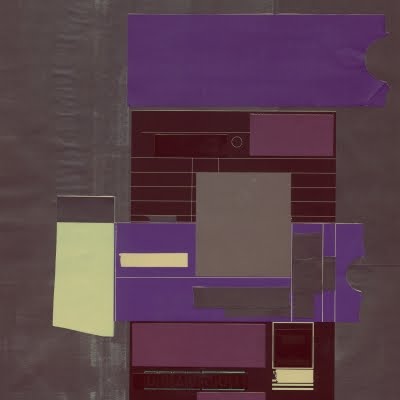
I've just been playing around with the forms generated by the video below while also incorporating some elements of the photographs I've taken. One of the images (printed and scanned as described in an earlier post) is above.

The circular shape is something that has come up time and time again throughout this process: from cymatics through to their appearance in the Kate Moross videos and back further to the work of John & James Whitney and Jordan Belson. It's probably through this relationship that I felt the visualization below - where a circle is reconfigured by the sound - was somehow appropriate. I think I'm also influenced by the fact that sound formats like vinyl and CD plus, of course, speakers are also round. In fact I tried applying some text to the above image and (while perhaps less to do with the circular image than its square proportions) it took on the appearance of an album cover.

06 April 2010

Library rhythm


Hardly likely to be crashing into the Top 40 anytime soon, the above was a test to see how the noise from the British Library could be arranged. All the audio is sourced from those London recordings with snippets organised to create a rhythm. I've also cobbled together a quick and very rough visualization video using imagery generated by the audio itself - seeing as it was getting uploaded to Youtube.

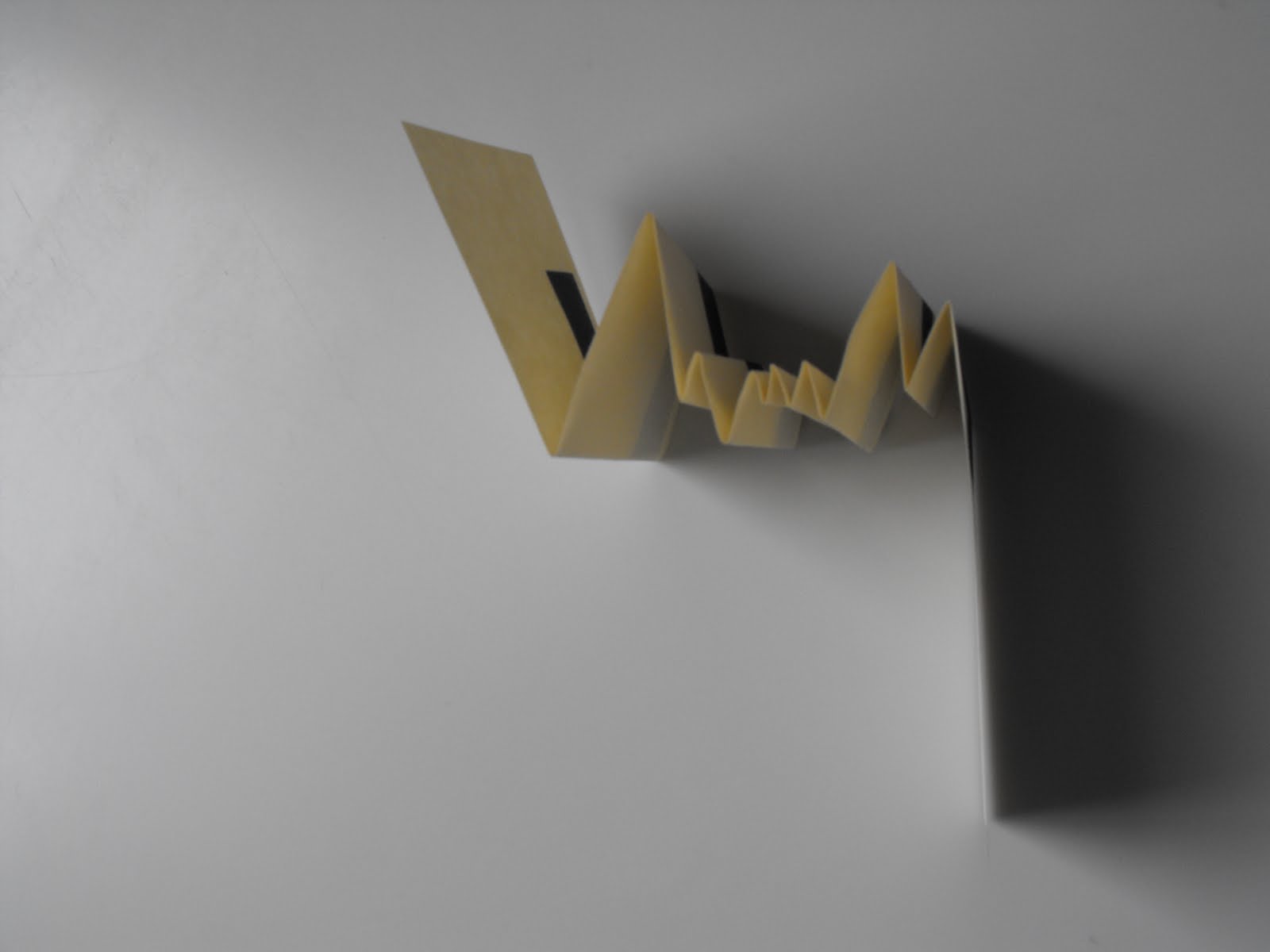
Waveform from folded paper


A little experiment to see what shape some of the waveforms might take if their line was used as a series of folds. I jotted this idea down ages ago so just wanted to get it out of my system here.

Another 2'03" Visualization


I'm currently cleaning up all the library audio tracks so that I can see if I can get some cymatic representations of the sound. While doing that, I thought I'd just note another couple of waveforms that were generated as part of the process.


Terry Riley - In C


A great modern U.S. label, Ghostly is releasing The Grand Valley State New Music Ensemble's version of In C which was composed by the influential Terry Riley. You can download an excerpt of it here.

The original is a landmark piece of minimal music comprising of 53 music "cells" that last between half a beat and 32 beats. It was written to be played by any number of musicians using any instruments. This latest version - performed by its 16-strong ensemble - comes with some beautiful artwork [pictured above, first image] that I think elegantly reflects the record's fusion of classical and contemporary. However two earlier recordings also tried to distil its parts into a visual form. Those are also pictured to note the different ways that the same experimental audio has been interpreted visually.

Some of the versions are available to purchase via the following links:

Riley, T - In C
Terry Riley in C

05 April 2010

David Toop website


I was reading up on David Toop given how his writing, curating and recording pushes into a number of experimental sound-related areas and noted the above on his website (http://www.davidtoop.com/). It's a flash animation where cubes shift from one side of the browser to the other. The user is encouraged to grab a cube and drag it to the speaker. Some are whizzing past while others are slower. And each plays a different sound: from what sounds like UFOs taking off through to jazz-edged interludes.

It's documented here simply as the record of something that is a bit of fun - a little add-on. Yet it's also indicative of how often we encounter one thing that's readable via one sense as an indicator of something that's more usually understood through a different sensory ability. For example, those TV adverts where someone places a new air freshener and suddenly we have a depiction of clean and curvy vapours emanating from the product. I suppose that's what I'm trying to do here: create a visual metaphor for this 'essence' of the British Library [an essence that has already been reduced to just its sonic manifestation].

Adam Brandon animation for The Album Leaf

Album Leaf Animation Test 2 from Adam Brandon on Vimeo.


I posted an earlier Adam Brandon visualization but I've since been looking at his Vimeo channel. From what I've seen it appears that he is particularly interested in visually representing sound. (For one project he attempted to create a visual notation for where silence exists.) It's certainly of interest give what I'm working on but it's even more intriguing given that he's studying in Manchester.

He also has two blogs on the go. The first is primarily touching on sound-related video at http://adams-sketchbook.blogspot.com/ while the other collects together the full range of his graphic design/communication/art direction passions at http://hello-mynameisadam.blogspot.com/.

Contributors

Followers